
Can AI-powered virtual agents reliably conduct research interviews in virtual reality? Findings presented at IEEE VR 2026 explored opportunities and limitations of LLM-driven agents for trustworthy and usable research practice.
Research connected to R-AIMS project was presented at the 33rd IEEE Conference on Virtual Reality and 3D User Interfaces (IEEE VR 2026), held in Daegu, South Korea, from 21-25 March 2026. The contribution was presented at the Workshop on Virtual Humans and Crowds in Immersive Environments (VHCIE) and explored the role of large language model (LLM)-driven virtual agents as research tools in immersive environments.
The study investigated whether an intelligent virtual agent (IVA) powered by a large language model can reliably conduct questionnaires directly in virtual reality (VR). Instead of relying on conventional 2D questionnaire interfaces with virtual keyboards, the approach explored whether spoken interaction with an embodied virtual agent could provide a more natural and usable alternative for collecting participant responses.
To examine this question, a within-subjects study with 36 participants compared two approaches: a spoken interview conducted by an LLM-based virtual agent in VR and a traditional questionnaire completed through a 2D interface. The research focused on measurement validity, data quality, technical robustness, user acceptance, usability, and workload effects – key considerations for the responsible use of AI-supported research methods.
The results showed that the virtual agent did not introduce systematic distortions in standardised Likert-scale responses. At the same time, participants provided substantially richer qualitative input: open-ended responses were approximately 3.5 times longer and around 40% more thematically diverse compared to keyboard-based text entry. Participants also reported lower physical strain during open-ended responses and rated the IVA-based interactions as more usable.
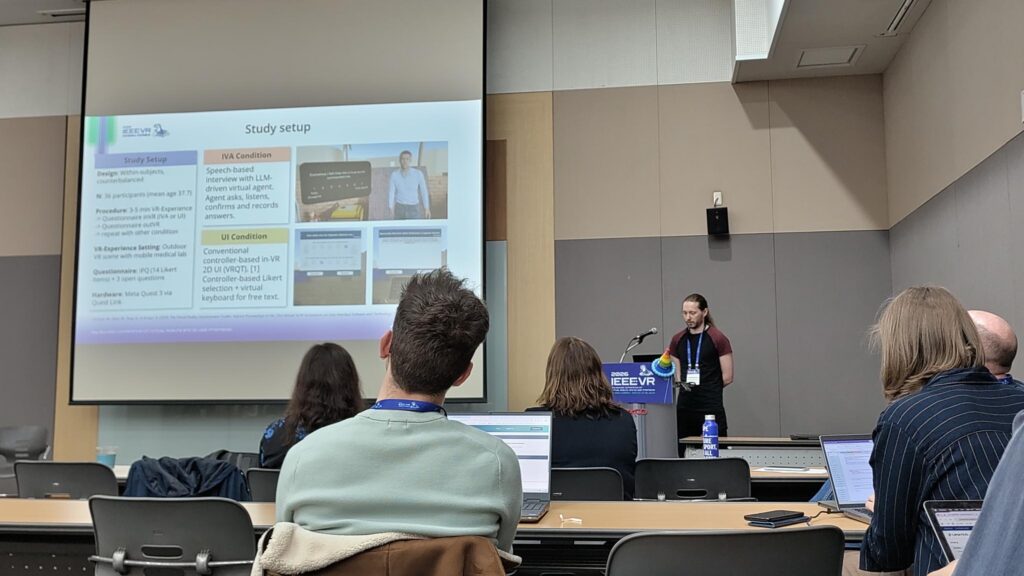
© Mirco Hülsemann / HAW Hamburg
At the same time, the study highlighted important limitations. While the LLM-driven agent proved feasible as an interview partner, occasional incorrect outputs demonstrated that such systems cannot currently be developed autonomously without safeguards. The findings therefore point towards more robust hybrid approaches, for example cpmbining rile-based interview structures with LLM-supported interaction as a fallback mechanism.
Within the context of R-AIMS, the contribution provides an application-oriented perspective on the responsible use of LLMs in research practice. By empirically evaluating validity, robustness, usability, and trust-related factors, the study contributes to broader discussions on how AI systems can be responsibly integrated into scientific methods and research environments.
Further information about the conference and workshop can be found on the IEEE VR 2026 and VHCIE websites.
Hülsemann, M., Langbehn, E. & Greule, R. (2026, March 21th – 25th): Conducting Questionnaire Interviews in Virtual Reality Using an Intelligent Virtual Agent [Conference paper]. 33rd IEEE Conference on Virtual Reality and 3D User Interfaces (IEEE VR), Daegu, South Korea.